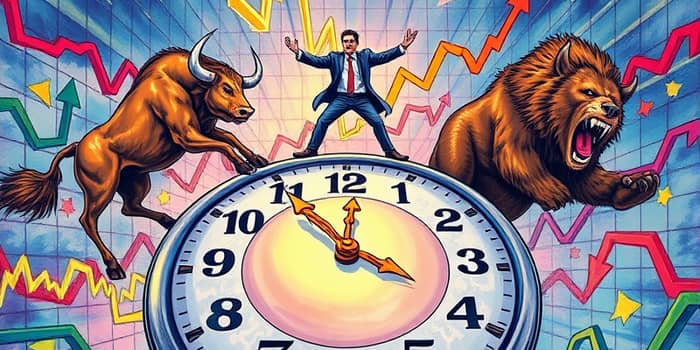
In an investing world filled with promises of quick wins and secret signals, the idea of timing the market shines like a tempting beacon. Yet beneath the allure lies a sobering reality: few succeed at predicting price swings consistently. This article dives into the evidence, history, and psychology behind why timing the market is so elusive, and shows how a disciplined approach often outperforms frenetic trading.
Market timing captivates imaginations because it suggests control over uncertainty. Who wouldn’t want to buy at the exact bottom and sell at the precise peak? However, decades of data, academic research, and real-world experience paint a very different picture. Before exploring why, we’ll define market timing and compare it with a more reliable alternative.
What Is Market Timing?
Market timing is an investment strategy where participants attempt to forecast future market movements to decide when to buy or sell assets. Its core promise is simple: buy low and sell high. Yet executing this with any reliability proves extremely challenging.
Investors employ various methods to time markets, including:
- Technical analysis of price and volume trends
- Fundamental analysis of economic and corporate indicators
- Quantitative models using statistical or algorithmic signals
Both short-term traders and long-term investors may use these tools. Day traders react to minute-by-minute chart patterns, while retirees might shift into cash ahead of perceived downturns. Despite its broad appeal, evidence rarely supports success over extended periods.
The Mechanics Behind Market Timing
At the heart of the market timing debate lies the Efficient Market Hypothesis (EMH), which argues that markets fully reflect all available information. Under EMH, price changes occur only when new data emerges, making it theoretically impossible to consistently beat the market through timing.
Mathematical and probabilistic models reinforce this view. Research shows that most market timers underperform a simple, diversified buy-and-hold portfolio over time. The distribution of possible outcomes for active timing is skewed: while a few may excel, the median and average returns lag behind static strategies.
Even the most sophisticated quantitative funds, armed with vast resources and cutting-edge algorithms, struggle to maintain long-term outperformance. The costs of frequent trading—transaction fees, taxes, and bid-ask spreads—further erode any theoretical edge.
Historical Performance and Research Findings
Numerous studies illuminate the pitfalls of market timing:
Professional fund managers, many of whom actively time their portfolios, consistently fail to beat benchmark indices. According to SPIVA scorecards, over 80% of actively managed funds lag their benchmarks across 15-year horizons.
Retail investors fare even worse. A landmark study by Barber and Odean found that frequent traders underperform the overall market, particularly during periods of volatility. Emotional reactions to news and fear of losses drive mistimed trades, resulting in lower net returns.
Perhaps most striking is the concentration of market gains in a handful of days. Research shows that 78% of the market’s best performing days occur during or immediately after bear markets. Missing just a few of these explosive upswings can devastate long-term wealth.
Probability and Behavioral Challenges
To outpace a static strategy, a market timer must achieve exceptionally high accuracy in forecasting both bull and bear markets. Historical data suggests you’d need to be correct 70–80% of the time on market direction—an almost impossible feat.
Even if one could reach such accuracy, human psychology presents another barrier. Fear of losses prompts investors to sell during downturns, only to miss the earliest and strongest phases of recoveries. Greed leads to chasing rallies at peaks. Such patterns result in buying high and selling low—exactly the opposite of the intended goal.
Behavioral biases, including herding, overconfidence, and regret aversion, further undermine timing efforts. Studies confirm that emotion-driven trades consistently produce poorer returns than decisions made according to pre-set plans.
Why Buy-and-Hold Wins Over Time
A disciplined, passive strategy—anchored in asset allocation and diversification—delivers superior results to most timing attempts. By staying invested, you capture the market’s full growth, including those critical rebound days.
Key advantages include:
- Lower costs from infrequent trading
- Reduced tax liabilities
- Emphasis on long-term trends rather than noise
Adopting disciplined, diversified, long-term holding shifts focus away from unpredictable daily fluctuations and toward sustained wealth building. Investors who rebalance periodically and resist emotional impulses tend to enjoy smoother, more reliable outcomes.
Conclusion
Market timing appeals to our desire for certainty and quick rewards. Yet the weight of evidence—from academic theory and empirical studies to real investor experiences—reveals how elusive and costly timing attempts can be.
Rather than chasing peaks and valleys, investors are better served by constructing a diversified portfolio aligned with their risk tolerance and objectives. Embracing a patient, buy-and-hold approach not only mitigates behavioral pitfalls but also ensures participation in the market’s most powerful growth phases.
Ultimately, true success in investing stems from staying the course through ups and downs. By focusing on fundamentals, costs, and emotional discipline, you can build lasting wealth without the stress and uncertainty of trying to beat the clock.
References
- https://corporatefinanceinstitute.com/resources/career-map/sell-side/capital-markets/market-timing/
- https://en.wikipedia.org/wiki/Market_timing
- https://www.covenantwealthadvisors.com/post/does-market-timing-work
- https://www.investopedia.com/terms/m/markettiming.asp
- https://pmc.ncbi.nlm.nih.gov/articles/PMC6051602/
- https://www.finra.org/investors/insights/market-timing
- https://www.hartfordfunds.com/practice-management/client-conversations/managing-volatility/timing-the-market-is-impossible.html