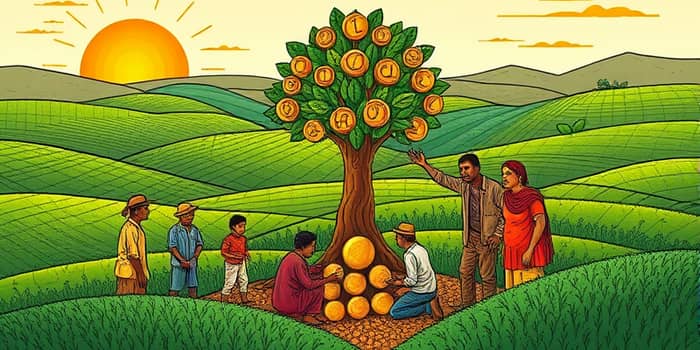
Rural cooperatives stand as enduring pillars in the agricultural landscape, uniting producers, lenders, and community leaders in pursuit of shared prosperity. From venerable grain elevators to modern value-added processing enterprises, these member-owned businesses demonstrate how pooling resources and sharing risks can drive collective success. As commodity prices rise and fall, and private credit shifts focus, the co-op model remains uniquely equipped to support small and medium producers, foster local development, and sustain financial resilience.
A Century of Resilience and Growth
At the dawn of the 20th century, over 10,000 agricultural cooperatives dotted the American countryside. Today, that number has declined to 1,621 agricultural cooperatives, yet membership holds strong at 1.84 million farmers and ranchers. These figures belie the profound influence co-ops wield: in 2022, they generated over $300 billion in gross business volume, a record high driven by robust commodity markets and strategic consolidation.
Longevity is a hallmark of cooperative success. Nearly one in four U.S. agricultural co-ops boasts over a century of operation, and more than half have weathered at least 75 years of market shifts, policy reforms, and demographic changes. This endurance testifies to driving grassroots governance and economic stability across generations, embodying a philosophy where every member has a voice and a stake in the enterprise.
Harnessing Internal Capital: Equity Strategies
Member equity forms the bedrock of cooperative capitalization. Unlike investor-owned firms, co-ops rely on member investments and retained earnings to fund operations, expansions, and technological upgrades. Three principal equity redemption systems have emerged:
Each method carries trade-offs. The revolving fund is simple but can delay redemption for active newer members. Age-based plans prioritize senior members, yet may not align with business growth. The base capital plan offers equitable and transparent equity management, but requires clear communication and administrative rigor.
Beyond redemption systems, co-ops encourage member borrowings as bonds—an approach that deepens engagement and ensures liquidity. This direct lending strengthens internal ties and reduces dependence on external credit.
Unlocking External Funding: Partnerships and Grants
To supplement internal equity, cooperatives tap an array of external funding sources. By forging strategic alliances and leveraging government programs, they broaden their capital base and mitigate risk.
- Cooperative finance corporations: Institutions like the National Rural Utilities Cooperative Finance Corporation extended over $6 billion in credit facilities in 2023, supporting infrastructure upgrades and expansion.
- USDA Value-Added Producer Grants (VAPG): With more than $31 million available annually, these grants provide planning funds up to $75,000 and working capital up to $250,000 for processing and marketing ventures.
- Socially-Disadvantaged Groups Grants (SDGG): Offering up to $175,000 for technical assistance, feasibility studies, and leadership training, SDGG prioritizes cooperatives serving underrepresented communities and persistent poverty counties.
- State and regional programs: From Brazil’s Pronaf lines for family farmers to U.S. state development grants, regional initiatives often deliver tailored credit solutions and low-interest loan pools.
By combining these resources, co-ops can finance everything from new processing lines to digital supply-chain platforms, reinforcing their competitive edge and community impact.
Overcoming Financial Hurdles and Challenges
Despite strong fundamentals, rural cooperatives face persistent obstacles. As generational succession unfolds, securing sufficient member equity for long-term growth can strain budgets. Meanwhile, balancing margin retention with annual equity redemptions demands strategic foresight.
Furthermore, many regions grapple with limited access to credit. Remote and persistent poverty counties often lack local banking partners willing to underwrite small loan portfolios. Although SDGG and similar programs provide relief, administrative complexity and eligibility criteria can deter smaller operations.
- Navigating competitive pressures from private lenders for larger producers.
- Communicating complex equity plans to a diverse membership.
- Maintaining sufficient retained earnings for asset modernization.
- Securing grants and matching funds amid shifting policy priorities.
Proactive governance and robust financial education empower co-ops to overcome these challenges. By cultivating financial literacy among members and fostering active participation, cooperatives ensure that governance decisions align with long-term capital strategies.
Emerging Trends and the Path Forward
As the agricultural economy evolves, cooperatives must adapt by embracing innovation and strategic policy engagement. Technology adoption—such as precision agriculture platforms and blockchain-enabled supply chains—enhances transparency, traceability, and efficiency.
Policy frameworks are also shifting to prioritize rural prosperity. Increased funding for disadvantaged communities and persistent poverty counties offers new avenues for co-ops to secure working capital and technical assistance. At the same time, consolidation trends drive operational efficiencies, enabling larger cooperatives to negotiate better terms on inputs and distribution.
- Enhancing operational efficiency and modernization through shared equipment and digital tools.
- Serving persistent poverty and disadvantaged groups with targeted grant programs and capacity-building initiatives.
- Generating a record over $300 billion in gross volume by leveraging national and global markets.
Ultimately, the cooperative movement thrives when members embrace their dual roles as users and owners. By engaging actively in governance, investing in equity, and pursuing innovative funding pathways, rural co-ops can secure lasting prosperity for their communities.
In an era of market volatility and evolving policy landscapes, the co-op capitalist’s vision—rooted in solidarity, shared risk, and inclusive governance—offers a powerful blueprint for sustainable rural development. Together, farmers and ranchers can continue to transform challenges into opportunities, ensuring that the cooperative spirit flourishes for generations to come.
References
- https://www.choicesmagazine.org/choices-magazine/theme-articles/critical-issues-for-agricultural-cooperatives/current-challenges-in-financing-agricultural-cooperatives
- https://sustainableagriculture.net/blog/funding-available-for-rural-farmers-and-cooperatives/
- https://www.fb.org/market-intel/the-crucial-role-of-farmer-cooperatives-and-why-active-participation-matters
- https://ideas.repec.org/p/ags/uersfc/314786.html
- https://www.rd.usda.gov/resources/publications-for-cooperatives