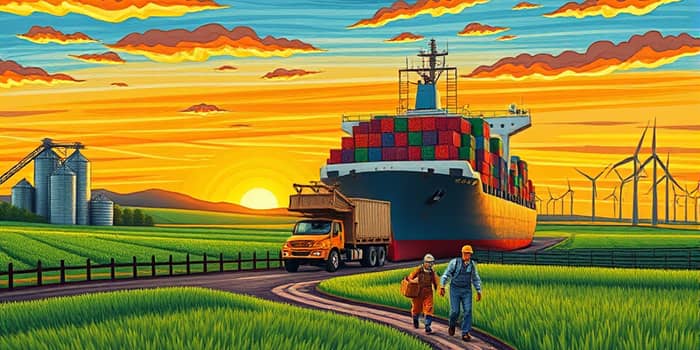
Rural America stands at a crossroads of tradition and transformation, poised to harness financial tools that can turn local investments into global successes. By leveraging targeted loans, community-driven initiatives can bridge infrastructure gaps, empower small businesses, and elevate local economies onto the world stage.
Understanding the Rural Export Landscape
In fiscal year 2025, U.S. agricultural exports are projected at $170.5 billion, a testament to American productivity and innovation. Yet imports are expected to hit $219.5 billion, resulting in a trade deficit of $49 billion. This disparity highlights the urgent need to bolster rural exporters’ capabilities and competitiveness.
Major export categories—grain and feed ($37.7 billion), oilseeds ($32.4 billion), and cotton ($4.1 billion)—reveal both strengths and vulnerabilities. Corn saw a $1.4 billion increase, while oilseeds faced a $1.1 billion decline due to South American competition. Rural manufacturers in metals and specialized sectors often match or exceed urban peers in export intensity per worker, but overall volumes lag because of resource and infrastructure shortfalls.
Empowering Communities with Loan Programs
Federal financing tools offer a lifeline for rural businesses embarking on export ventures. The USDA’s suite of loan and guarantee programs is designed to catalyze growth, create jobs, and diversify local economies.
- Business and Industry (B&I) Guaranteed Loans: In FY 2025, $2.3 billion in guarantees support start-up capital, expansions, and job creation.
- GSM-102 Export Credit Guarantees: $5 billion in coverage reduces lender risk, enabling small producers to access international markets.
- Meat and Poultry Intermediary Lending: Part of a $583 million investment to enhance processing capacity and local employment.
New initiatives like the Local Meat Capacity Grant and Indigenous Animals Processing Grants target niche markets, promoting resilience and cultural heritage while fostering export-ready operations.
Overcoming Challenges on the Path to Trade
Despite available funding, rural exporters face persistent obstacles that require strategic intervention and community collaboration.
- Access to finance: Fewer trade finance services and limited working capital impede international sales.
- Infrastructure gaps: Inadequate broadband and transportation networks restrict market reach.
- Labor shortages: Demographic shifts and immigration policies complicate workforce stability.
Policy volatility after election cycles can alter trade rules, creating uncertainty. Additionally, market risks—fluctuating commodity prices, tariffs, and intense global competition—demand robust risk management and diversification strategies.
Seizing Opportunities and Policy Recommendations
To close the urban-rural export gap and support sustainable growth, stakeholders should champion place-based policies that tailor resources to community needs and strengths.
Recent legislation—the Inflation Reduction Act, CHIPS Act, and Infrastructure Investment and Jobs Act—allocates roughly $440 billion or 43% of funding as “rural relevant.” Strategic allocation of these funds can transform digital connectivity, logistics, and workforce development.
Key policy recommendations include:
- Expanding digital infrastructure: Broadband access directly correlates with higher cloud adoption and export intensity, enabling remote market research and e-commerce.
- Investing in human capital: Trade education, mentorship programs, and market analysis services equip rural exporters with vital skills and intelligence.
- Strengthening supply chain resilience: Funding aggregation, processing, storage, and distribution facilities reduces bottlenecks and enhances global competitiveness.
Specialty and value-added markets—such as bioenergy feedstocks and high-quality meat exports—offer premium pricing and diversification benefits. Direct support for these niches can generate higher returns and create unique brand identities for rural regions.
Key Federal Investment Breakdown
Looking Ahead: Sustainable Growth and Innovation
The road to 2025 and beyond is paved with challenges, but also ripe with opportunities. A strong dollar, evolving trade policies, and fierce global competition may temper short-term export growth. Yet these pressures can also drive innovation in sustainable practices, precision agriculture, and value-added processing.
Research into crop genetics, carbon-friendly farming methods, and renewable bioenergy feedstocks aligns with rising global demand for eco-conscious products. Rural communities that embrace these trends can position themselves as leaders in emerging markets—ranging from sustainable aviation fuels to plant-based proteins.
Case studies illustrate the transformative power of targeted investments. A Midwestern grain cooperative used B&I loans to install advanced drying and storage systems, boosting export volumes by 20%. A Southern poultry processor expanded with intermediary lending, entering Caribbean and Latin American markets for the first time. In the Northwest, a bioenergy startup leveraged USDA guarantees to scale production of feedstocks destined for European refineries.
Echoing expert voices, Amitrajeet A. Batabyal urges a focus on place-based interventions that respect local assets, while CoBank analysts stress the need for policy stability and reliable labor pipelines. Together, these insights form a blueprint for lasting rural prosperity.
A Call to Action for Community Leaders
Rural stakeholders—farmers, entrepreneurs, policymakers, and lenders—must collaborate to unlock the full potential of local loans. By aligning resources with community strengths, investing in people and infrastructure, and embracing innovation, rural America can rewrite its export narrative.
Financial resilience and global ambition are not mutually exclusive. With every loan approved, every training session held, and every infrastructure gap bridged, local communities inch closer to realizing global dreams. The path forward demands vision, persistence, and partnership, but the rewards—economic vitality, job creation, and a more balanced trade ledger—are within reach.
References
- https://finance-commerce.com/2025/05/rural-manufacturing-trade-deficit-exports/
- https://californiaagnet.com/2024/12/14/rural-industries-disproportionately-exposed-to-federal-policy-facing-downside-risks-in-2025/
- https://www.cobank.com/knowledge-exchange/general/the-year-ahead-forces-that-will-shape-the-us-rural-economy-in-2025
- https://agamerica.com/blog/agricultural-trade-q1-2025/
- https://onlinelibrary.wiley.com/doi/10.1002/jaa2.70009
- https://www.bea.gov/news/2025/us-international-trade-goods-and-services-april-2025