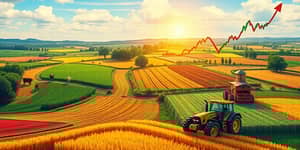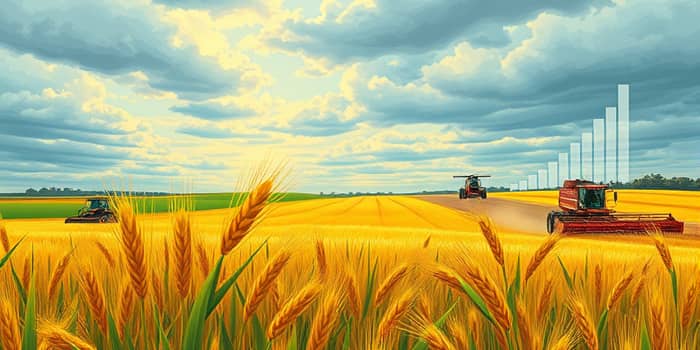
As global populations swell and diets evolve, agricultural commodities emerge as the new form of “green gold,” offering incentives for producers and investors alike. By understanding market forces and embracing resilience, stakeholders can navigate volatility and seize opportunities in 2025 and beyond.
Global Market Dynamics
After a decade of rapid price surges, the sector is entering a phase of modest declines—with a projected 1% drop in overall agricultural prices in 2025. Yet beneath this headline figure lies a landscape of contrasts, shaped by supply improvements, persistent demand, and unpredictable weather events.
Major segments such as grains, oilseeds, tropical crops, and dairy remain at the forefront of global trade. Even as wheat and milk prices are forecast to fall by 9.7% and 11.0% respectively, soybeans are expected to enjoy 12% export growth driven by strong Asian and South American consumption.
Key Drivers Shaping Demand and Supply
Markets respond swiftly to a range of influences. Producers who monitor and adapt to these forces can build more robust enterprises.
- Extreme weather and climate variability disrupt yields, especially in North America and Australia.
- Rising incomes and dietary shifts in emerging markets bolster feed grain consumption for meat and dairy.
- Government biofuel mandates and subsidies support sustained demand for corn, sugarcane, and oilseeds.
- Population growth across Asia and Africa underpins rising food demand and export potential.
- Logistical bottlenecks and labor shortages heighten supply chain risks and price spikes.
Price Forecasts and Outlook for 2025
While overall food-at-home inflation in the U.S. is expected to moderate to 2.2%, individual commodity segments will diverge significantly based on weather, seasonality, and policy shifts.
This table highlights just how varied the outlook can be, even as the World Bank predicts a mild 1% decline in agricultural prices overall.
Emerging Opportunities for Producers and Investors
Amid moderate price corrections, several bright spots promise growth and resilience. Farmers and investors who align strategies with these trends can harvest significant returns.
- Strategic biofuel policy support creates stable demand floors for corn, sugarcane, and oilseeds.
- Investment in export infrastructure enhances market access to fast-growing Asian and South American consumers.
- Sustainable soil health and straw management practices improve yields and long-term resilience.
- Integrated market and risk management tools guard against abrupt price fluctuations and shocks.
By cultivating these opportunities today, stakeholders can build supply chains that thrive even under stress.
Risks and Resilience Strategies
Volatility remains a constant companion in agricultural markets. Those who anticipate challenges and prepare accordingly can emerge stronger.
- Abrupt weather-related supply shocks demand diversified crop portfolios and flexible planting schedules.
- Geopolitical tensions and trade barriers call for vigilant policy monitoring and alternative market planning.
- Compressed farm margins necessitate precision cost management and value-added crop processing.
- Supply chain and labor challenges encourage on-farm mechanization and local workforce development.
Combining these resilience measures with real-time data and predictive analytics helps stakeholders steer through uncertainty.
Looking Ahead: Long-Term Trends
Beyond 2025, global agricultural trade is poised for sustained expansion, with developing economies continuing to drive consumption and innovation. USDA forecasts project U.S. exports to remain a major force through 2034, even as climate adaptation and digital farming reshape the landscape.
Adopting resilient and adaptive farming practices, leveraging biotechnology, and investing in renewable energy integration will be key. Market participants who embrace collaboration—between governments, producers, and financiers—stand to benefit from emerging financing models and risk-sharing platforms.
Ultimately, “green gold” represents more than commodity profits. It embodies a shared future where innovation, sustainability, and prudent policy converge to nourish the world. By aligning with these principles, stakeholders can cultivate not only crops, but also prosperity for communities and generations to come.
References
- https://farmonaut.com/blogs/agriculture-commodity-prices-2025-market-trends
- http://www.ers.usda.gov/data-products/food-price-outlook/summary-findings
- https://www.rabobank.com/knowledge/q011460376-agri-commodity-markets-outlook-2025-fat-tariffs-lead-to-slim-margins
- https://blogs.worldbank.org/en/developmenttalk/the-commodity-markets-outlook-in-eight-charts1
- https://rootagadvisory.com/commodity-market-outlook/
- https://www.aberdeeninvestments.com/en-us/institutional/insights-and-research/commodities-the-year-that-was-the-year-that-could-be-2025-inst
- https://www.usda.gov/about-usda/general-information/staff-offices/office-chief-economist/world-agricultural-outlook-board/baseline-projections
- https://www.jpmorgan.com/insights/payments/payment-trends/commodities-market-trends