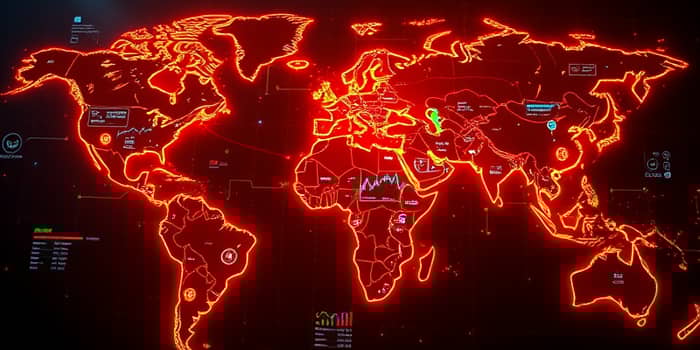
The foreign exchange market stands as the beating heart of global finance. In this article, we delve into its vast scale, dynamic structure, and practical strategies for traders seeking to navigate its ever-shifting currents.
Historical Growth and Present Scale
Over recent decades, the forex market has cemented its position as the largest and most liquid asset market in the world. From $6.6 trillion in daily turnover in 2019 to a record $7.6 trillion daily turnover in 2022, its expansion reflects surging cross-border trade, digital access, and investor appetite for currency speculation and hedging.
To put this into perspective, the market’s estimated total value of $2.4 quadrillion dwarfs annual global GDP by about 17 times. Day after day, currencies trade in volumes more than 35 times those of the entire Nasdaq stock market.
Market Structure and Key Segments
The forex arena is built on a variety of instruments tailored to different needs—immediate exchange, future settlement, hedging, and speculation. Thanks to electronic trading platforms boosting accessibility, traders of all scales can engage around the clock.
- Spot Trading: Immediate currency exchanges.
- Forwards and Options: Contracts for hedging or speculative strategies.
- Swaps: Currency swap agreements for set future dates.
Participants range from global banks to individual retail traders, each influencing market liquidity and volatility.
- Reporting Dealers: Major banks and liquidity providers.
- Financial Institutions: Hedge funds, pension funds, and corporates.
- Retail Traders: Smaller investors accessing markets via online brokers.
Geographical Insights
Though forex is inherently global and decentralized, certain regions dominate activity. North America and Europe have traditionally led, with London hailed as the world’s forex capital. New York, Tokyo, and Singapore follow closely, while Asia-Pacific sees rapid growth driven by expanding economies and digital adoption.
Emerging markets such as Brazil, India, Vietnam, South Africa, and Saudi Arabia are playing an increasingly pivotal role, reflecting rising trade volumes and local investment interests.
Growth Drivers and Current Trends
Several forces propel the market forward, shaping both volume and volatility.
- Globalization: Cross-border trade reached $32 trillion in 2022, fueling currency demand.
- Digital Transformation: User-friendly platforms democratize access.
- COVID-19 Impact: Retail activity surged, especially among millennials.
- DeFi & Cryptocurrency: Blurring lines between digital assets and forex strategies.
- Shifting Dollar Confidence: Investors diversify away from the USD into alternative assets.
The recent decline in dollar confidence—from 45% to 34% in early 2025—has spurred traders to diversify into gold and crypto, further enriching market dynamics.
Statistics & Key Figures
Forex trading unfolds 24 hours a day, five days a week, via over-the-counter networks without a centralized exchange. Retail traders account for about 5.5% of volume, yet their presence has grown substantially thanks to fintech innovations. Institutional players and corporations drive the majority of transactions, leveraging sophisticated hedging and investment strategies.
Projected market size is expected to climb from $2.4 trillion in 2023 to $3.5 trillion by 2032, at a CAGR of 4.2%. Concurrently, the forex broker segment may expand even faster, reaching $13 trillion by 2032.
Future Outlook and Practical Strategies
The future of forex trading is intertwined with technological advancements, regulatory evolution, and global economic shifts. As the Bank for International Settlements prepares its next major survey in late 2025, participants can anticipate ongoing transparency and deeper insights into regional activity.
For traders seeking to harness this vast market, consider these practical steps:
- Choose a Reliable Platform: Prioritize robust tools, security protocols, and transparent fee structures.
- Diversify Risk: Balance currency pairs with different volatility profiles and consider alternative assets.
- Stay Informed: Monitor global trade data, central bank policies, and geopolitical events impacting currencies.
- Implement Risk Management: Use stop-loss orders, position sizing, and hedging strategies.
- Leverage Education: Engage with credible resources, coursework, and community forums to refine skills.
Above all, maintain discipline and adaptability. The forex market’s continuous expansion offers boundless opportunities for those equipped with strategy, resilience, and a commitment to lifelong learning.
By understanding its scale, structure, and driving forces, traders can confidently explore global currencies and craft sustainable pathways to success in the world’s most dynamic financial market.
References
- https://dataintelo.com/report/foreign-exchange-market
- https://www.globenewswire.com/news-release/2025/02/20/3029771/28124/en/1-16-Trillion-Foreign-Exchange-Markets-Global-Industry-Trends-Opportunity-and-Forecast-2020-2024-2025-2030.html
- https://www.bestbrokers.com/forex-trading/forex-trading-statistics/
- https://tokenist.com/investing/forex-statistics/
- https://www.bestbrokers.com/forex-trading/forex-daily-trading-volume/
- https://www.bis.org/statistics/rpfx25_announcement.htm
- https://www.technavio.com/report/foreign-exchange-market-industry-analysis
- https://www.thebusinessresearchcompany.com/report/foreign-exchange-global-market-report