As agribusiness moves into 2025, farmers, lenders, and investors face a landscape reshaped by economic forces, technology and sustainability demands. Understanding these converging trends is crucial for thriving in the years ahead.
Macroeconomic Conditions and Sector Outlook
The year 2025 marks a significant upswing, with net farm income forecast at $180.1 billion, up nearly 29.5% over 2024. This surge is driven largely by enhanced direct government payments boost farm stability and modest improvements in sector equity.
Farm sector equity is projected to grow by 4.3% to $3.83 trillion, while total assets rise by 4.2% to $4.40 trillion. Despite these gains, debt also climbs 3.7% to $561.8 billion. The resulting debt-to-asset ratio holds near 12.8%, a level that suggests manageable but rising indebtedness across the industry.
Marketplace Trends: Lending and Credit Supply
Commercial banks report higher farm lending demand at commercial banks, especially for larger operating loans. Yet availability of funds is declining, with Federal Reserve districts in Chicago and St. Louis showing reduced credit since late 2022.
Farmland financing rates globally range between 4.5% and 8.5% per annum, reflecting a moderate interest environment. The Federal Reserve’s projected target for the federal funds rate—3.75% to 4.00%—could provide relief if inflation trends soften as expected.
- Increased loan demand for machinery and input financing
- Rising delinquency rates, yet below crisis thresholds
- Shifting collateral values as real estate softens in key regions
Digital Transformation in Financial Management
Rapid adoption of cloud-based accounting and mobile banking is transforming traditional record-keeping. AI-driven analytics and blockchain platforms bring unprecedented transparency and speed to transactions.
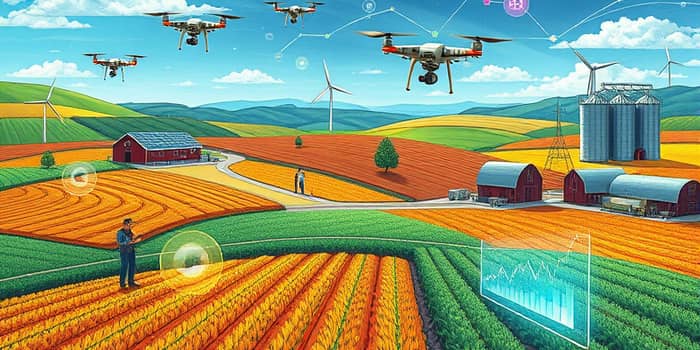
Internet of Things (IoT) devices capture real-time field data, feeding into big data analytics for precise budgeting, forecasting, and risk assessment. These digital tools enable farmers to make informed decisions, optimize cash flow, and reduce exposure to price volatility.
- FinTech microloans and digital insurance solutions
- Blockchain-based supply chain traceability
- Satellite imagery integrated into credit assessment
Sustainability and Climate-Linked Financing
More than 60% of farmland loans now incorporate environmental criteria. Institutions offer sustainability-linked loans and green bonds that reward practices like cover cropping, water conservation, and biodiversity enhancement.
Parametric insurance products, powered by satellite data, automate indemnity payments when specified climate thresholds are exceeded. Carbon footprint tracking and blockchain traceability give farmers leverage to negotiate better rates and access premium markets.
Farmer Profitability, Risk Management and Government Support
Direct government payments, forecast at $42.4 billion in 2025, play a pivotal role in cushioning revenue swings. This increase of $33.1 billion over 2024 helps offset rising input costs, particularly in regions affected by recent disasters.
Profitability broadly mirrors 2024’s levels, although farms that saw working capital declines may face repeated challenges. Softening real estate values in certain markets also impact borrowing capacity and collateral strength.
Future Outlook and Key Drivers
Looking ahead, three drivers will shape agribusiness finance: evolving inflation trends, supply chain resilience, and climate risk. Should inflation cool as projected, input prices and borrowing costs could stabilize, easing pressure on margins.
Supply chain uncertainties—driven by geopolitical shifts and consumer preferences—will demand adaptive strategies and diversified market channels. Meanwhile, lenders and insurers will increasingly tie financing rates to environmental performance, making sustainability a core business imperative.
Embracing digital innovation and climate-smart practices will not only protect the bottom line but position farmers at the forefront of a resilient, profitable future. By understanding these trends and leveraging available tools, agribusiness can navigate uncertainty and thrive in 2025 and beyond.
References
- https://farmonaut.com/blogs/agribusiness-financial-management-7-key-strategies-2025
- https://www.kansascityfed.org/agriculture/agfinance-updates/
- https://farmonaut.com/blogs/farmland-financing-rates-2025-for-sustainable-agriculture
- http://www.ers.usda.gov/topics/farm-economy/farm-sector-income-finances/farm-sector-income-forecast
- https://ag.purdue.edu/commercialag/home/paer-article/2025-agricultural-credit-outlook/
- https://www.agweb.com/opinion/snapshot-u-s-agricultural-economy-2025
- https://farmdocdaily.illinois.edu/2025/02/what-a-farms-2024-financial-performance-indicates-about-2025.html
- https://www.stlouisfed.org/on-the-economy/2025/jan/us-farmers-continue-face-headwinds