Rural economies have long relied on primary agriculture and local labor to sustain livelihoods. Yet, the winds of change are driving families and communities toward new horizons.
By embracing innovation and exploring alternative enterprises, rural households can build greater stability and prosperity beyond soil and livestock.
Understanding the Changing Landscape
The era of historic dependence on primary agriculture is evolving. While farming remains central, diverse activities are gaining traction across the countryside.
Data from recent surveys reveal the breakdown of primary income sources in many rural regions:
While contract farming accounts for 28.3% of household income, less common streams such as handicrafts and seasonal work hint at untapped potential.
Why Diversification Is Crucial for Rural Resilience
Relying heavily on a single sector leaves families vulnerable to market swings, weather events, and policy shifts. Income shocks can push households into instability or debt.
Projections for 2025 underscore this: net farm income is expected to jump nearly 30%, but largely due to a government payments rising from $9.6 billion to $42.4 billion, not stronger commodity markets.
Building robust portfolios of enterprises enhances household resiliency to economic shocks and balances seasonal fluctuations.
Key Avenues for Diversification
Shifting from mono-production to multiple ventures can create stable, year-round revenue. Rural innovators are tapping several promising pathways:
- Value-added agricultural processing and tourism
- Handicrafts and home-based production
- Remote self-employment and e-commerce
- Renewable energy land lease projects
- Recreational services and rural tourism
- Technology services and gig work
Many farmers are turning raw crops into artisanal goods—jams, cheeses, and pickles—while hosting visitors for farm-to-table experiences under value-added agricultural processing and tourism.
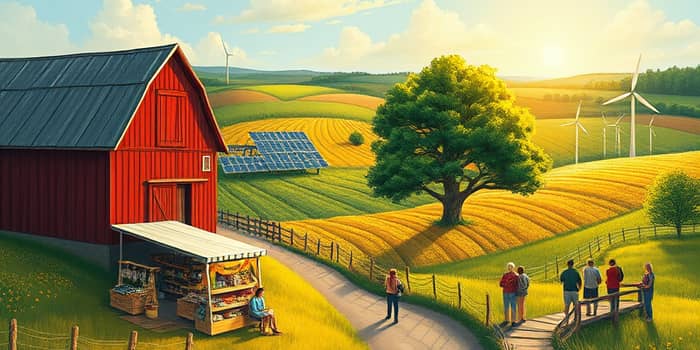
Leasing fields for solar panels or wind turbines provides steady rental income and supports the energy transition. These renewable energy land lease projects can outlast commodity cycles and require minimal daily management.
With reliable internet, rural residents increasingly offer freelance design, virtual assistance, and online tutoring, accessing global markets from their kitchen tables.
Support Structures and Programs
Growing networks of mentors, trainers, and funding sources empower entrepreneurs to launch and scale new ventures.
- Community-based resource centers and incubators
- Microloans, grants, and cooperative financing
- Mentorship and peer-to-peer learning
Organizations such as the Center for Rural Affairs and ACEnet’s Food Ventures Center exemplify how community-based organizations for mentoring and training can transform ideas into profitable enterprises.
Initiatives like Missouri’s Codefi connect rural youth with coding bootcamps and tech internships, laying foundations for lasting economic growth.
Overcoming Barriers and Building Capacity
Despite promise, rural entrepreneurs face hurdles: limited capital, patchy internet, and skill gaps. Addressing these requires coordinated action.
Local stakeholders must invest in infrastructure upgrades, from broadband to roads, while fostering partnerships with educational institutions.
Targeted programs offering digital skills training and mentorship programs can equip residents to seize e-commerce and remote work opportunities.
Raising awareness of available resources through community forums and local media ensures no one is left behind in the diversification journey.
Looking Ahead: The Future of Rural Economies
As 2025 unfolds, the urgency for sustainable, self-driven income sources intensifies. Policymakers, nonprofits, and private investors must collaborate to scale successful models.
By nurturing innovation hubs, improving access to finance, and championing rural talent, communities can unlock emerging rural opportunities and collaborative ecosystems that redefine prosperity.
Ultimately, moving beyond the barn is not just about chasing numbers, but about empowering people—preserving way of life, while planting the seeds for thriving, resilient futures.
References
- https://pmc.ncbi.nlm.nih.gov/articles/PMC12192180/
- https://jsbs.scholasticahq.com/article/29468-an-overview-of-rural-entrepreneurship-and-future-directions
- https://agamerica.com/blog/farm-income-2025/
- https://www.sog.unc.edu/resources/microsites/building-assets-rural-future/support-rural-low-wealth-entrepreneurs
- https://farmpolicynews.illinois.edu/2025/02/farm-income-to-increase-in-2025-thanks-to-federal-aid/
- https://commercialbiotechnology.com/article-detail/?id=1067
- http://www.ers.usda.gov/data-products/charts-of-note/chart-detail?chartId=110894
- https://www.score.org/resource/article/opportunities-and-obstacles-rural-entrepreneurs