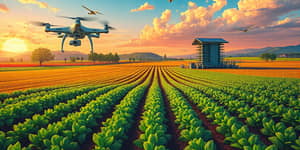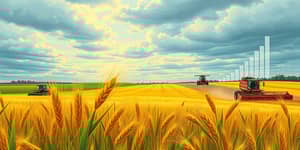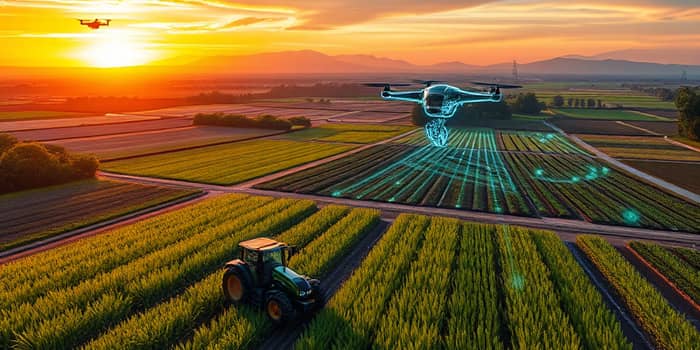
In an era defined by climate challenges and technological breakthroughs, agriculture stands at a transformative crossroads. The rise of agritech promises to redefine farming for a growing global population, offering new ways to nurture the earth and feed billions.
Market Size and Growth Prospects
The global agritech market was valued at between $24.42 and $28.2 billion in 2024 and is projected to surge to $48.98 billion by 2030, achieving a compound annual growth rate (CAGR) of 12.3%. Some analysts forecast even more ambitious expansion, estimating a market worth of $106.4 billion by 2034 at a 14.4% CAGR.
Sub-markets such as agritech platforms alone are expected to hit $15 billion in 2025, expanding at 15% annually through 2033. Venture capital and corporate investment have poured into startups that harness AI, robotics, and IoT, signaling strong industry confidence.
These figures underscore a broader shift: agriculture is no longer just labor and land; it has become a digital battleground where innovation drives productivity gains and environmental stewardship hand in hand.
Key Drivers of Growth
Several fundamental forces are propelling the agritech revolution:
- sustainable agricultural practices and conservation driven by urgent environmental imperatives.
- rapid deployment of precision agriculture using GPS-guided tools and sensor networks.
- digital transformation of farm management through AI-powered analytics and mobile platforms.
- climate-resilient farming and resource efficiency to counter unpredictable weather patterns.
- supportive government policies worldwide fostering investment and research.
By leveraging these drivers, farmers and agritech firms are crafting holistic solutions. For example, sensor arrays paired with AI forecasting enable more accurate irrigation schedules, reducing water waste while securing yields.
Leading Technologies and Trends
The agritech landscape is defined by a convergence of advanced tools that integrate seamlessly into modern farming:
- precision agriculture, AI, IoT, robotics enabling pinpoint resource application and yield optimization.
- smart sensors and connected devices offering real-time monitoring of soil health, water usage, and crop vitality.
- autonomous tractors and robotic harvesters addressing labor shortages and boosting operational efficiency.
- supply chain digitization for transparency from farmgate to consumer plate, enhancing traceability.
- vertical farming and controlled environment agriculture expanding crop production in urban centers and arid zones.
- genetic engineering and smart seed technologies improving resilience, yield, and nutritional content.
Beyond hardware, software platforms are providing dashboards that unify weather data, crop models, and financial planning. This holistic approach empowers farmers to make informed decisions at every stage of the growth cycle.
Market Segmentation
Understanding the diverse segments within agritech is crucial for targeted innovation and investment:
- By Solution Type: Biotechnology & biochemicals, big data analytics, sensors, IoT devices, and mobility platforms.
- By Application: Production and maintenance, irrigation management, livestock monitoring, precision aquaculture, supply chain optimization, and greenhouse control.
- By Region: North America and APAC lead adoption, followed by Europe, Latin America, and the Middle East & Africa.
This segmentation highlights opportunities for startups and established players to specialize and collaborate across service lines and geographies, ensuring tailored solutions meet diverse local needs.
Major Players and Market Share
A handful of global companies command a significant share of the agritech arena, while nimble startups continue to innovate at the edges. Understanding who holds market influence offers insight into partnership and competition opportunities.
Startups such as CropX, Farmers Edge, Arable, and Gamaya are also shaping the market with specialized AI, drone, and blockchain applications for niche challenges in water management, pest prediction, and transparent trade.
Opportunities: The Alpha Factor
“Agritech Alpha” points to the unlocking of untapped potentials across the agricultural ecosystem. For smallholder farmers in developing regions, tailored, affordable platforms for smallholders can democratize access to best practices and precision tools, bridging the gap between burgeoning technologies and those who need them most.
Data-driven advisory services, underpinned by data-driven advisory and marketplace models, promise to bridge information gaps, empowering farmers to negotiate better prices, optimize inputs, and make strategic planting decisions.
Climate-smart interventions will bolster resilience, providing real-time adaptation strategies that protect harvests from unpredictable weather stressors. Meanwhile, integrated finance and insurance products built on continuous agronomic data can de-risk operations, paving the way for broader investment and rural economic development.
Challenges and Barriers to Adoption
Despite its promise, agritech faces hurdles. Limited rural connectivity in emerging economies hampers the deployment of IoT networks and data analytics, while high initial capital requirements deter small and medium farms from adopting advanced machinery.
Interoperability between proprietary platforms remains a technical challenge, necessitating industry collaboration on open standards and data sharing protocols. Regulatory fragmentation and data privacy concerns further complicate implementation, underscoring the need for harmonized policies and farmer education initiatives.
Finally, building trust in data-centric practices requires sustained outreach and demonstration projects that showcase tangible productivity and sustainability gains.
Regional Growth Dynamics
North America leads with robust investment, a strong startup ecosystem, and early adopter farmers who quickly embrace innovation. APAC follows closely, driven by large agrarian economies in China, India, and Southeast Asia, where technology transfer can leapfrog legacy processes.
Europe’s focus on sustainability and improved resource efficiency has birthed strict environmental regulations that drive adoption of eco-friendly solutions. In Latin America and the Middle East & Africa, improving connectivity and local infrastructure offers significant potential for leapfrogging to digital-first farming models.
Collaboration between governments, NGOs, and private firms in these regions can accelerate infrastructure upgrades, ensuring that the most vulnerable farming communities benefit from the agritech revolution.
Future Outlook: Crafting a Sustainable Tomorrow
Between 2025 and 2034, the agritech sector is poised for sustained expansion. Year-over-year growth is expected to range from 9% to 15%, influenced by sub-segment dynamics and regional policy landscapes.
The interplay of AI, robotics, IoT, gene editing, and platform business models will continue to redefine value creation. Collaborative ecosystems—where farmers, tech firms, investors, and policymakers converge—will be critical to scaling solutions that are both profitable and environmentally responsible.
Investors and entrepreneurs should monitor emerging clusters in APAC and Africa, where young populations and rich agricultural heritage create fertile ground for rapid deployment of next-generation technologies.
Conclusion: Empowering the Next Generation of Farmers
As we stand on the cusp of an agritech revolution, convergence of AI, robotics, and IoT offers a glimpse into a future where agriculture is more productive, resilient, and sustainable than ever before.
By unlocking new market potentials and bridging divides between technology and tradition, Agritech Alpha empowers farmers worldwide to cultivate abundance responsibly. Now is the moment to invest, collaborate, and innovate—to grow not only crops, but a brighter future for generations to come.
References
- https://www.arizton.com/market-reports/agritech-market
- https://www.precisionfarmingdealer.com/articles/6551-global-agritech-market-expected-to-grow-to-4898-billion-by-2030
- https://www.businesswire.com/news/home/20250514544509/en/Agritech-Market-Global-Outlook-Forecast-Report-2025-2030-Competitive-Analysis-of-AGCO-Bayer-Crop-Science-CNH-Industrial-Corteva-Agriscience-John-Deere-Kubota-Syngenta-and-Trimble---ResearchAndMarkets.com
- https://www.archivemarketresearch.com/reports/agritech-platform-276090
- https://www.insightaceanalytic.com/report/agritech-market/2546
- https://www.globenewswire.com/news-release/2025/05/13/3080018/0/en/Agritech-Market-Global-Outlook-Forecast-Report-2025-2030-Rise-of-Vertical-Farming-and-Controlled-Environment-Agriculture-and-Increased-Investments-in-Agri-Biotechnology-and-Sustain.html
- https://eos.com/blog/agritech-market-overview-and-trends-for-2025-2030/
- https://www.statista.com/statistics/1222528/worldwide-agricultural-technology-market-value/